


2020 – CHW
I went looking in a field which frequently has giant mushrooms in it but it had been recently grazed by cattle and these two were all I found. My new book, the Collins Complete Guide to British Mushrooms and Toadstools, suggests these are ‘Parasols’ (Macrolepiota procera). A fairly common mushroom but not clear if it is edible?
Macrolepiota proceraMacrolepiota procera
A good array of salvias in Jaimie’s new garden.
Salvia x jamensis ‘Hot Lips’ and Salvia ‘Amistad’.
salvias
Salvia ‘Amethyst Lips’ in a pot.
Salvia ‘Amethyst Lips’
The newly planted Ternstroemia aff. chapensis. A new species here.
Schefflera macrophylla has died following its blowing over in a summer gale which broke its root system.
Schefflera macrophylla
Gevuina avellana is not looking well after two dry summers. Only tiny flowers. Probably needs a hard pruning to reshoot from the base.
Gevuina avellana
Schefflera pauciflora with seed heads forming.
Schefflera pauciflora
And another one with almost ripe seed heads which are now purplish-black.A replacement Schefflera macrophylla planted this year.
Schefflera macrophylla
The flower on Oreopanax incisus is now full out.
Oreopanax incisus
A roe deer buck has attacked a eucalyptus with its horns in the rutting season.
eucalyptuseucalyptus
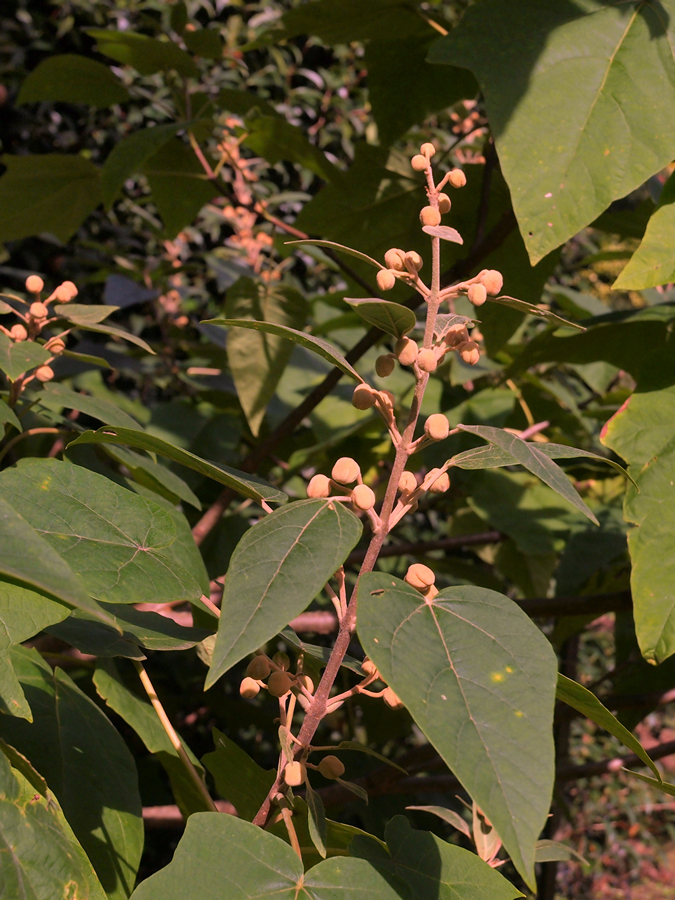
Secondary new growth with numerous flower buds on Paulownia kawakamii which I have not seen before. Only a few flowers previously on this huge tree in the last couple of years.
Paulownia kawakamiiPaulownia kawakamii
Berries on Cornus iberica. Deer nibbling here too.
Cornus ibericaCornus iberica
One of Dad’s original Rhododendron ‘Red Centurion’ covered in secondary flowers. Again not seen previously.
Fruits on Vaccinum ovatum (?) – it may be another species?
Vaccinum ovatum
The best thing in the garden today is Schima khasiana. I was very wrong to say it was having a year off flowering but, 10 days ago, there did not seem to be any obvious buds!
Schima khasianaSchima khasianaSchima khasiana
2019 – CHW
A search for fruits and berries on the drive.
Stewartia rostrata with plump seed heads which are nearly ripe. The recent strong winds have blown many onto the ground so Asia needs to keep an eye on what are left.
A few unripe seeds still left on Stachyurus praecox. At the same time the flower stalks for next year are fully developed and a couple have yellow flowers already out.
Stachyurus praecoxStachyurus praecox
Heptacodion miconoides just going over. The branches are laden down with flower heads and seeds forming. A few moths and butterflies were enjoying the nectar but too quick to photograph.
Heptacodion miconoidesHeptacodion miconoides
A top grafted Crataegus x grignonensis laden with large red fruits which the pheasants do not seem to like.
Crataegus x grignonensisCrataegus x grignonensis
A top grafted Sorbus reducta which the pheasants have found more attractive.
Sorbus reducta
2018 – CHW
The Lapageria ‘Picotee’ has suddenly produced a huge cluster of flowers 10-12ft from the ground and growing up over some Camellia sasanqua. Quite the best it has ever performed.
Lapageria ‘Picotee’Lapageria ‘Picotee’
2017 – CHW
Sycopsis tutcheri is doing well and the buds showing at the end of the twigs may yet turn into early spring flowers. It is clearly an evergreen species with a dainty leaf arrangement.
Lindera lancea (Lindera umbellata var lancea perhaps) is producing a wonderful show of yellow autumn colour. Planted in 2011 it is now romping away with next year’s new growth (or flowers?) clearly visible at the tips of the twigs. A hard frost could do some damage here.
Lindera lanceaLindera lancea
Ilex cornuta is doing pretty well too nearby. A very dense habit indeed. Suitable as a hedging plant I suspect.
Ilex cornutaIlex cornuta
2016 – CHW
Just look at the multitude of flower buds for next spring on Paulownia elongata!
Paulownia elongataPaulownia elongata
Enkianthus serrulatus has a very distinct bronze tone in the autumn. Earlier and perhaps better than other species?
Enkianthus serrulatusEnkianthus serrulatus
A young seedling from our now long dead original Acer forrestii is doing well. We have planted many out but I can never find them. The reddish secondary new growth gives it away.
Acer forrestii
2015 – CHW
A good specimen of Acer campestre which I think I planted as Acer campestre ‘Carnival’ which is supposed to have creamy white margins to the leaves. These are nowhere to be seen today but white variegation is often irregular or patchy and may only be apparent in spring. The tree has a compact habit with delicate and intricate leaves which will soon turn yellow.
Acer campestreAcer campestre
Cornus kousa ‘Wendel Weeping’ has a few smallish fruits but is not going to be anything startling in this department.
This website uses cookies to improve your experience. We'll assume you're ok with this, but you can opt-out if you wish.AcceptRead More
Privacy & Cookies Policy
Privacy Overview
This website uses cookies to improve your experience while you navigate through the website. Out of these, the cookies that are categorized as necessary are stored on your browser as they are essential for the working of basic functionalities of the website. We also use third-party cookies that help us analyze and understand how you use this website. These cookies will be stored in your browser only with your consent. You also have the option to opt-out of these cookies. But opting out of some of these cookies may affect your browsing experience.
Necessary cookies are absolutely essential for the website to function properly. This category only includes cookies that ensures basic functionalities and security features of the website. These cookies do not store any personal information.
Any cookies that may not be particularly necessary for the website to function and is used specifically to collect user personal data via analytics, ads, other embedded contents are termed as non-necessary cookies. It is mandatory to procure user consent prior to running these cookies on your website.